 Check Price on Amazon
PNY NVIDIA GeForce RTX™ 5070 OC Triple Fan Buying Guide — Black Friday Deals 2026
Choosing an RTX 5070 for a Black Friday build is less about chasing a headline and more about checking whether the exact card fits your planned setup. The PNY NVIDIA GeForce RTX™ 5070 OC Triple Fan listing gives shoppers several concrete details to assess: memory, boost speed, interface, video outputs, thickness and fan count. Those specifications can help you compare the card with your own requirements, but they do not establish a sale price or tell you whether an offer is worthwhile. During Black Friday, confirm that the listing is for this exact PNY model before weighing the terms shown against your budget and build plans.
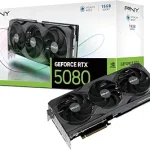
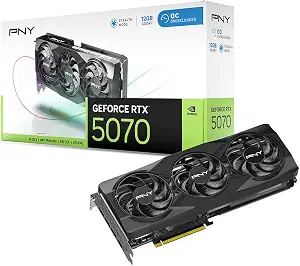
Best for shoppers who specifically want a triple-fan configuration, the PNY NVIDIA GeForce RTX™ 5070 OC Triple Fan lists three fans alongside 12GB GDDR7 memory and a boost speed of 2587 MHz. That label describes a configuration preference, not a claim that the card will outperform another model. For a Black Friday comparison, use the full product name and listed details to distinguish this card from other RTX 5070 variants. If you are saving listings for later, keep the model identity with the offer so you do not compare details from different cards by mistake.
The listed 192-bit memory bus, PCIe® 5.0 interface and HDMI®/DP 2.1 video outputs give you further points to check against the requirements for your intended setup. The card is listed as 2.4-Slot thick, a detail to consider alongside the space available in your planned build. Before purchasing during Black Friday, consult the documentation for your other components and check the exact listing details rather than assuming fit from the RTX 5070 name alone. The practical decision is whether the specifications and physical form described on the listing suit the way you intend to use the card.
Start with the space available in your build
The PNY card’s listed thickness is 2.4-Slot, so make room for that exact form factor in your planning. Check your case and component layout against their own documentation, and consider where the graphics card will sit relative to the surrounding parts. The product facts do not provide the card’s full dimensions, so do not treat the slot-thickness detail as a complete fit check. If the listing provides additional measurements, compare those with your own space requirements before deciding.
This check is especially useful during Black Friday, when several similar RTX 5070 listings may appear in a shopping session. Keep the PNY model name beside the 2.4-Slot detail as you compare offers; a different card’s measurements should not be carried over to this one. If you are still choosing a case or planning a compact build, make physical fit a decision point before focusing on the offer. A listing that looks attractive is only relevant if its stated dimensions work for your intended arrangement.
Read the memory and boost details as separate clues
This model lists 12GB GDDR7 memory and a boost speed of 2587 MHz. Treat those as two separate specifications when you compare cards: one identifies the listed memory configuration, while the other is the stated boost-speed figure. The facts here do not establish results for particular games, creative applications or settings, so avoid turning these figures into a promise about how a specific workload will run. Instead, compare them with the requirements and priorities you have already identified.
For a Black Friday shortlist, record the exact figures beside the full product name. That makes it easier to notice when another listing describes a different RTX 5070 variant, even if the product titles look similar at a glance. If your intended software publishes specific hardware requirements, use those requirements as a separate reference rather than assuming the listing alone answers every question. The useful outcome is a clearer comparison, not an unsupported performance prediction.
Check the memory bus in your comparison notes
The listed memory bus for this PNY RTX 5070 is 192-bit. It is a distinct specification from the 12GB GDDR7 memory entry, so keep both details visible if you are comparing product pages. A short note with the model name, memory type, capacity and bus width can prevent confusion between cards that share the RTX 5070 family name. The supplied listing facts do not explain how this specification translates into results for a particular use, so rely on your requirements rather than guessing from the number alone.
Black Friday can make quick comparisons tempting, but the clearest choice comes from matching like with like. Check that the capacity, memory type and bus width you have written down all belong to the exact PNY model under consideration. Then weigh those details alongside the rest of the configuration and the offer displayed for that variant. This approach helps you make a deliberate decision without treating one specification as a standalone verdict.
Map the interface and outputs to your plans
The listing identifies a PCIe® 5.0 interface and HDMI®/DP 2.1 video outputs. Use those labels as prompts to check the requirements of the rest of your setup: consult your motherboard information for the interface question, and check your display documentation for the connection details you need. The provided facts do not specify a count of each output or establish compatibility with a particular system, cable or display, so verify those specifics before ordering.
When Black Friday listings are open side by side, compare the output and interface wording on the exact product pages rather than relying on a category label or a remembered specification. This is particularly useful if your intended setup has specific display connections or a defined component plan. Make a list of the details you need to confirm, then resolve any uncertainty from the relevant product documentation before checkout. That is more reliable than assuming every RTX 5070 listing has identical connections.
Treat three fans as a configuration choice
Three fans are explicitly listed for this card. That makes the fan count a straightforward way to distinguish the PNY NVIDIA GeForce RTX™ 5070 OC Triple Fan from models whose configuration may be described differently. The supplied facts do not state temperatures, noise levels or cooling results, so the fan count should not be used to promise any of those outcomes. Consider it one part of the product’s described design and decide whether that configuration is what you want.
For a Black Friday purchase, make sure the exact listing title and variant still identify the Triple Fan model when you review the offer. If a page presents several options, check that the selected option matches the card whose specifications you compared. Keep the fan configuration in perspective alongside the 2.4-Slot thickness, interface, outputs and memory details. Taken together, those points give you a more useful basis for deciding whether this particular card belongs on your shortlist.
Key specs
| Memory | 12GB GDDR7 |
| Boost speed | Boost Speed: 2587 MHz |
| Memory bus | 192-bit |
| Interface | PCIe® 5.0 |
| Video outputs | HDMI®/DP 2.1 |
| Card thickness | 2.4-Slot |
| Fans | Number of Fans 3 |
Make your Black Friday choice
A careful Black Friday decision starts with the exact PNY NVIDIA GeForce RTX™ 5070 OC Triple Fan listing, then checks its 12GB GDDR7 memory, 2587 MHz boost speed, 192-bit memory bus, PCIe® 5.0 interface, HDMI®/DP 2.1 outputs, 2.4-Slot thickness and three-fan configuration against your own plans. Confirm the selected variant and review the offer actually displayed before buying; no specification alone establishes whether a deal is right for you. If the model, fit and listed details align with your requirements, you can compare the offer on its own terms rather than relying on assumptions about other RTX 5070 cards.